What Should You Check When Visiting an Apartment?
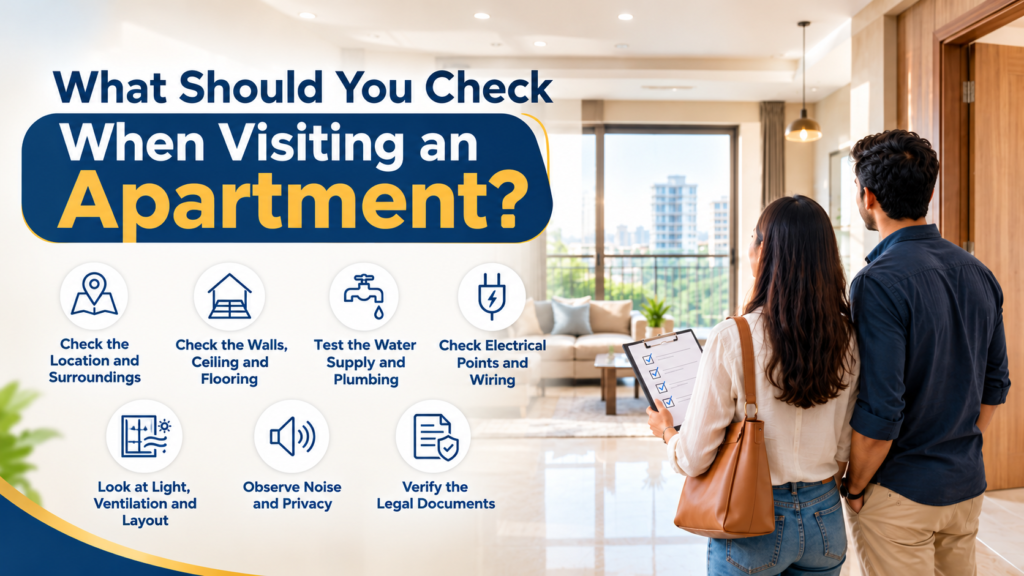
Buying an apartment is one of the biggest decisions of your life. A site visit is your best chance to see beyond brochures and 3D renders. Many buyers get impressed by a model flat and forget to check the things that matter every single day after moving in. Use this checklist on your next visit so you can decide with confidence.
Check the Location and Surroundings
Start before you enter the building. Look at the neighbourhood the way you would if you already lived there.
Check the distance to schools, hospitals, markets and public transport. Drive the route to your workplace at peak hours to understand the real travel time. Look at the road condition and width, especially during or after rain. Observe noise levels, nearby construction and any industrial activity around the project.
Inspect the Building Exterior and Common Areas
The common areas tell you a lot about how well the project is built and managed.
Look for cracks, dampness or paint peeling on the outer walls. Check the condition of the lobby, staircase, corridors and lifts. Confirm that there is a power backup for lifts and common lighting. Check the parking space, its size, ease of movement and visitor parking. Look at the security setup, including gate control, CCTV and intercom. If the project has a clubhouse, pool or play area, confirm they are actually built and not just promised.
Check the Walls, Ceiling and Flooring
Inside the apartment, look closely at the finishing.
Check ceilings and wall corners for damp patches or hairline cracks. Press your hand on walls to feel for moisture. Inspect the flooring for level surfaces, gaps between tiles and hollow sounds when tapped. Look at the quality of paint, doors and window frames. Open and close every door and window to check smooth movement and proper locking.
Test the Water Supply and Plumbing
Water issues are among the most common complaints in apartments.
Turn on all taps and showers in each bathroom and kitchen to check water pressure. Flush the toilets and check how quickly water drains. Look under sinks and around fittings for leaks. Ask about the water source, whether it is municipal supply, borewell or both, and about the storage capacity of the overhead and sump tanks. Check bathroom and balcony slopes so that water flows towards the drain.
Check Electrical Points and Wiring
Safe wiring is not something you can fix easily later.
Count the switches and plug points in every room and compare them with your needs. Check that the electrical panel has proper circuit breakers. Test switches and sockets by plugging in a phone charger. Confirm that provisions exist for air conditioners, geysers and a washing machine. Ask about the power backup arrangement inside the apartment.
Look at Light, Ventilation and Layout
A good apartment feels bright and airy without needing lights and fans all day.
Visit at different times of the day if possible to see how much natural light enters. Check cross ventilation between windows and doors. Stand in each room and imagine your furniture. Make sure the layout offers usable space without wasted corridors. Check the balcony size and the view it offers. Ask which direction the apartment faces, as this affects heat and light.
Check the Kitchen and Bathrooms
These are the most used spaces, so inspect them carefully.
Look at the kitchen platform height and size, the sink position and the storage options. Check for an exhaust provision and a separate utility or wash area. In bathrooms, check the quality of fittings, tiles and ventilation. Ensure there is proper waterproofing, since seepage is a major issue during the monsoon.
Observe Noise and Privacy
Spend a few minutes in silence inside the flat. Listen for traffic noise, lift sounds and sounds from neighbouring apartments. Check how much privacy your windows and balcony give from nearby buildings.
Verify the Legal Documents
A beautiful flat is worthless without clear paperwork. Ask to see the following before you pay any significant amount.
RERA registration number of the project. Approved building plan and building permit. Land title documents and encumbrance certificate. Completion or occupancy certificate for ready homes. Builder buyer agreement with clear payment terms and handover date. Bank approvals if you plan to take a home loan.
You can verify the RERA details yourself on the official Kerala RERA website.
Understand the Costs and Maintenance
Ask for a full cost breakdown so there are no surprises later. This includes the base price, car parking charges, club membership, registration and stamp duty, GST where applicable, and the corpus fund. Also ask about monthly maintenance charges and what services they cover.
Talk to Existing Residents and Check the Builder’s Track Record
If the project is partly occupied, speak to residents about water supply, maintenance, security and builder responsiveness. Look at the builder’s earlier projects, check whether they were delivered on time and see how well those buildings have aged.
Final Tips for Your Site Visit
Visit more than once, ideally at different times of day and once after rain if possible. Carry a notepad, a phone for photos, a measuring tape and a phone charger to test sockets. Bring a family member or a friend for a second opinion. Never rush your decision because of limited time offers.
Conclusion
A thorough site visit can save you from expensive repairs, legal trouble and daily frustration. Take your time, check every point on this list and ask questions without hesitation. A good builder will always be happy to answer them.
Planning to buy an apartment? Visit the Opendoorsteps website to explore apartments, compare options and find the right home for you.