West-facing house good or bad according to Vastu?
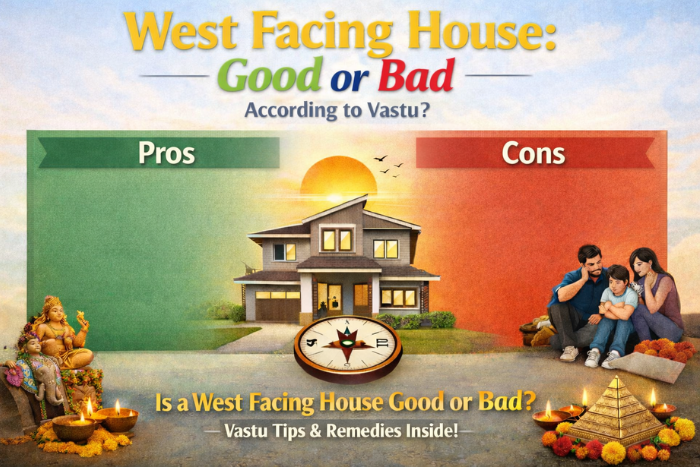
Vastu plays an important role in balancing the positive and negative energy in a home or one’s life. The Vastu can fetch a good positive spirit and the Vastu defects will cause negative energy, which symbolises negative aspects of life. Thus, for a house to become a home, it needs to radiate the right kind of energy. Generally, all the directions are equally good to orient a house, but still, west-facing houses rank behind the north and east-facing houses. But they are not inauspicious indeed. As per Vastu rules, west-facing houses also bring the same level of harmony and positivity as the top two choices – provided one follows certain west-facing Vastu rules. Further, read this article on, Is West facing house good or bad according to Vastu? for details…
How Auspicious Are West-Facing Homes According To Vastu?
West-facing house
Many people find it difficult to identify the orientation of the house. The House orientation can be recognised by one simple action. Stand inside the house/residence or the site and face out of the main door or gate, as the case may be. The direction you face is said to be the site or house orientation. So, if you face west, then it is a west-facing house/residence.
Who is the lord of the west direction?
This direction is ruled by Lord Varuna. Dev. Varuna has one face and two hands. He has a serpent in the right hand and a rope in the left hand. Also, known as the lord of rains, which is essential for human beings and all other living things. In some areas, the west-west-facing direction may also be called Padamara disa, Paschim Disha, Varun dikh, etc.
What does Vastu Shastra say about west-facingavoiding houses?
Many Vastu specialists say that living in a south or west-facing house will invite trouble in life, and thus only east or north-facing properties are considered good. However, this is a false myth propagated to make you spend money on solutions as suggested by the specialists. In reality, as per Vastu Shastra, all the directions are equally prosperous, and the auspiciousness of a home doesn’t depend upon the direction. The most important factor is the correct placement of the main or the entrance door. For every direction – be it North, East, South or West, Vastu Shastra lays specific rules for locating the main entrance door of the house. So, if you are planning to build a new house or own a property, being aware of the likely effects can prepare you for what to expect.
According to Vastu, what tips should one follow in the west-facing houses?
- Locate/place the entrance in the 3rd, 4th, 5th or 6th padas in the Westside.
- You can also use 1st and 2nd padas if you want.
- The walls in South and West must be thicker and higher than those in the East and North.
- Place the kitchen in the South East or North West of the house, avoid the South West.
- The master bedroom in the southwest direction is the best
- If the house has multiple floors, then pinpoint the master bedroom on the highest floor.
- Kid’s room can be in the South, West or North-West directions.
- A guest bedroom can be placed in a North-West direction.
What should one avoid in the west-facing houses?
- Evade placing the entrance in the 7th, 8th and 9th padas on the Westside.
- Avoid locating a bore-well or water sump in the southwest part of the site. As open spaces are best kept away from the Western direction and perform positively when placed on the Eastern side.
- Never buy a plot or flat with an extension in the South or South West.
- Avoid having a Kitchen in the southwest part of the house.
Vastu tips on location of the main door in the west-facing houses?
As per Vastu Shastra, homeowners who are building or buying new properties must ensure that the main door is located within the right ‘padas’ or steps. The count of padas is derived by dividing the house into 9 equal parts, starting from the north-west corner to the south-west end. The 3rd, 4th, 5th, and 6th padas are the most auspicious for main doors in west-facing houses as it ushers in positivity and good vibes.
Do’s about west-facingthe houses
- When planning a house, provide more open space towards the east direction. Lower the house and provide less open space towards the west direction (as more open space towards the east direction removes all kinds of obstacles).
- The west floor being high and sloping towards the East is an optimal situation.
- Low level or ditches towards the Northeast are important.
- Planting heavy trees in the West is greatly valuable. It can protect you from various difficult situations.
- Constructing solid rock platforms at the west open site is the best solution for many problems, including health and finances.
- According to west-facing house Vastu principles, colours such as white, silver, yellow and beige are best suited for west-facing homes. Equally, these colours are said to maximise the profits and gains that come from the Western direction.
What are the advantages of west-facing houses?
- Those who live in houses in this direction have bold opinions in their activities.
- Generally, they are cautious and observant in their approach and will not allow others to dominate them.
- They will be strict in extracting work from others.
- They are bold and generous people.
- Have positive bonding with the near and dear ones.
- This direction blesses energy for planning, working, etc.
- This direction is responsible for one’s professional or trade and standard in their business development.
- West direction gives natural sunlight till late hours.
- Four of the demi-Gods, Pushpadanta, Varuna, Asura and Mitra occupy this sector.
Conclusion
Finally, west-facing houses are most suitable for people having professions like teachers, politicians, religious priests, and corporate businessmen. However, using these Vastu tips, homeowners can maximise the power of the direction and channel harmony and positivity throughout their homes.