5 Critical Mistakes to Avoid When Buying a Flat in Kerala
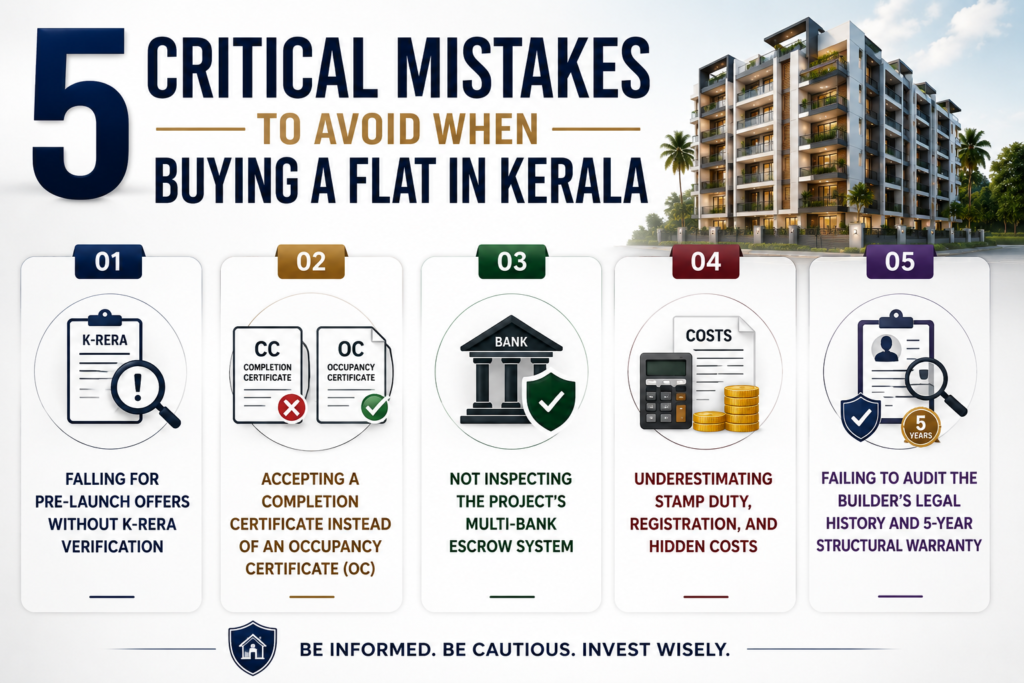
5 Critical Mistakes to Avoid When Buying a Flat in Kerala Buying an apartment is a dream milestone, especially for families and NRI investors looking for premium properties in Kerala’s booming real estate hubs like Kochi, Trivandrum, and Kozhikode. The Kerala real estate market has witnessed remarkable growth over the past decade, driven by rising NRI remittances, rapid urban infrastructure development, and a highly educated, aspirational middle class eager to own quality homes.
However, with stricter regulations swinging into action under K-RERA guidelines, relying on glossy brochures or builder promises is no longer enough. The stakes are higher than ever property prices in prime locations like Marine Drive in Kochi, Kowdiar in Trivandrum, and Calicut Beach Road in Kozhikode have surged significantly, making every investment decision critical.
A single oversight in paperwork or legal compliance can lock up your hard-earned money for years sometimes even permanently. Worse, many buyers discover these mistakes only after signing the Sale Deed, leaving them with little legal recourse. To protect your investment and ensure complete peace of mind, make sure you strictly avoid these 5 critical mistakes when buying a flat in Kerala. For more insights on property buying errors, check out the Top 10 Mistakes to Avoid When Buying Property.
1. Falling for Pre-Launch Offers Without K-RERA Verification
Many buyers fall into the trap of heavily discounted pre-launch or “coming soon” offers. Unscrupulous builders use these emotionally charged tactics to collect substantial advance cash before even securing mandatory government clearances. The promise of an exclusive early-bird discount of ₹5–10 lakhs sounds attractive but the financial and legal risks hidden behind unregistered projects can far outweigh any savings.
In multiple documented cases across Kerala, buyers who booked flats based on pre-launch brochures alone found their projects stalled for 3 to 7 years, with no refunds and no construction progress. The builder had simply vanished or filed for insolvency, leaving hundreds of families in financial distress with no roof over their heads and no money to start over.
How do I check if a project is K-RERA approved?
Under the latest real estate guidelines, it is strictly illegal for any developer to market, advertise, or accept bookings for a project without an official K-RERA registration number. This rule applies equally to print advertisements, digital campaigns, social media posts, and even word-of-mouth referrals backed by a formal booking form.
To verify a project before paying a single rupee, start by locating the unique K-RERA registration number and the mandatory QR Code on the project’s marketing materials, brochures, or sales office display boards. Then visit the official Kerala RERA web portal at rera.kerala.gov.in and search using the registration number to access the live digital dashboard. This dashboard provides verified layout approvals, structural plans, the official construction timeline, and the developer’s full compliance history. Finally, cross-check the developer’s name, promoter details, and project address against the registration certificate to ensure nothing has been misrepresented.
Always insist on a registered builder-buyer agreement before making any payment. A mere receipt or an informal MOU is not legally binding under K-RERA and offers you zero protection if the project fails.
2. Accepting a Completion Certificate Instead of an Occupancy Certificate (OC)
One of the most dangerous and surprisingly common mistakes first-time homebuyers make is confusing a Completion Certificate with an Occupancy Certificate. Many builders hand over possession of flats armed only with a Completion Certificate, and uninformed buyers accept it without question setting themselves up for serious legal and financial consequences that can last for decades.
Is an Occupancy Certificate (OC) mandatory in Kerala?
Yes, absolutely and non-negotiably so. A Completion Certificate simply means the building’s physical structure has been completed as per the approved plan. It does not confirm safety, habitability, or legal compliance with local body norms.
The Occupancy Certificate, issued exclusively by the local municipality, corporation, or panchayat after a formal physical inspection, is the final legal stamp confirming that the building is entirely safe, structurally sound, and fit for permanent human habitation.
Without a valid Occupancy Certificate, you cannot legally occupy the flat under Kerala’s building rules. You cannot obtain a permanent electricity connection from KSEB or a permanent water connection from KWA, forcing you to depend on temporary connections indefinitely. You cannot apply for property tax reassessment, meaning you may be paying inflated taxes year after year. Banks will refuse to sanction home loans for any future resale transaction involving the flat, effectively killing your exit strategy and dramatically reducing the property’s market value. In some municipalities, the local body even holds the legal authority to seal and demolish unauthorized structures that lack a valid OC.
Always demand the original Occupancy Certificate before signing the possession handover letter. If the builder claims it is still “in process,” legally delay your possession date until the document is physically in your hands.
3. Not Inspecting the Project's Multi-Bank Escrow System
Financial mismanagement has historically been the single most devastating reason behind stalled and abandoned real estate projects across India, and Kerala is no exception. For years, unethical builders freely diverted funds collected from buyers in one apartment project to purchase land or fund overhead costs for an entirely different development leaving the original project permanently incomplete. Buyers were left trapped, paying EMIs on home loans for apartments that would never be built and fighting expensive, decade-long legal battles with no guarantee of recovery.
What is the RERA bank account rule for builders?
To permanently eliminate this devastating risk, strict regulations now mandate a Three-Bank-Account System that creates full financial transparency and traceability for every registered project in Kerala.
The first account is the RERA Collection Account. Every single rupee of booking amounts, installment payments, and construction-linked payments made by buyers must be deposited into this traceable, registered account first without any exception. The second is the RERA Separate Escrow Account, into which a mandatory 70% of all collected funds is automatically transferred. These funds can only be withdrawn to cover the actual, verified land acquisition and construction costs of that specific registered project alone. No diversion to any other project or expense head is legally permitted. The third is the RERA Transaction Account, which holds the remaining 30% allocated for the developer’s marketing expenses, administrative overhead, and other controlled operational costs.
Before signing any agreement, ask the builder to provide the registered bank account details for all three accounts in writing. Confirm that your payment receipts specifically mention the RERA Collection Account number. You also have the right under K-RERA provisions to request quarterly financial statements from the builder and to independently check the project’s Quarterly Progress Reports available on the K-RERA portal, which track actual construction completion percentages against the promised timeline.
4. Underestimating Stamp Duty, Registration, and Hidden Costs
A shockingly large number of buyers set a hard, non-negotiable budget based purely on the base selling price quoted by the builder’s sales team only to face severe financial strain, personal loan dependency, or even complete deal collapse when the final payment invoice arrives packed with additional statutory charges and hidden fees that nobody warned them about upfront.
The truth is that the true all-in cost of purchasing a flat in Kerala is consistently 12 to 17 percent higher than the base price quoted in the brochure. For a flat priced at ₹80 lakhs, that means an additional ₹10 to ₹14 lakhs in charges that must be paid from your own savings not covered by your home loan.
What are the actual property registration charges in Kerala?
When budgeting for an apartment in Kerala, always remember that all government taxes and statutory charges are calculated on whichever figure is higher your formal agreement value or the local government’s Fair Value, which is the minimum government-assessed market rate for that specific locality and property type.
Stamp Duty is charged at 8% of the property value and is the single largest additional cost you will face. Registration Charges are an additional 2% of the property value, payable directly at the Sub-Registrar’s office on the day of registration. GST on under-construction property is currently 5% for luxury residential housing, while GST on ready-to-move-in property is 0% — but only if the builder already holds a valid Occupancy Certificate at the time of sale.
Beyond these statutory charges, you must separately budget for advocate and legal due diligence fees ranging from ₹15,000 to ₹50,000 depending on complexity, a maintenance corpus deposit of ₹1 to ₹3 lakhs paid upfront to the housing society, home loan processing fees of 0.5 to 1% of the total loan amount charged by the bank, and interior modification and furnishing costs which are never included in the builder’s quoted price.
Also read the fine print of your builder agreement carefully for escalation clauses. Some contracts legally allow builders to raise the base price if construction material costs increase beyond a certain threshold, which can silently add several lakhs to your final invoice with no warning.
5. Failing to Audit the Builder’s Legal History and 5-Year Structural Warranty
Even if the location is absolutely prime and the apartment looks stunning in the showroom model, buying from an unverified, first-time, or financially stressed developer is a serious gamble with your life savings and your family’s future security. Poor construction quality caused by substandard cement grades, inadequate steel reinforcement, or artificially rushed construction timelines typically manifests as plumbing leaks, hairline wall cracks, waterproofing failures, terrace seepage, and elevator breakdowns within just months of moving in. This directly and immediately translates to falling resale value, expensive out-of-pocket repairs, and bitter disputes with a builder who suddenly becomes unreachable.
What are the common legal document checks before buying an apartment?
Before signing the final Sale Deed, your appointed legal advisor must physically audit and verify the original copies of all the following critical documents.
The Title Deed, also known as the Parent Deed, establishes clear, undisputed, and unbroken land ownership history for a minimum of 30 years prior to the current sale. Any gap, irregularity, or disputed entry in the ownership chain is a serious red flag that can result in lengthy court disputes over the very land your apartment stands on sometimes erupting years after you have moved in and settled your family.
The Encumbrance Certificate, issued by the Sub-Registrar’s office, definitively verifies that the land is completely free of all legal claims, court attachments, outstanding liabilities, or active bank mortgages. An EC with any entries whatsoever means the land is legally or financially compromised and must be avoided without exception.
The Panchayat or Municipal Building Permit confirms that the approved building plan precisely matches the actual structure being constructed floor by floor. Any deviation between the sanctioned plan and the actual construction can trigger demolition orders or heavy penalty notices from the local body, which become the buyer’s problem after registration.
For projects situated near coastal areas, backwaters, rivers, or protected ecological green zones in Kerala, CRZ clearance and Environmental Clearances from the relevant government authorities are absolutely essential. Projects missing these clearances in sensitive zones are frequently subjected to legal stays that halt all construction indefinitely, trapping your entire investment in a legal limbo that can drag on for years.
Finally, and critically, ensure that the 5-Year Structural Warranty Clause is explicitly, specifically, and enforceably written into your registered builder-buyer agreement. Under K-RERA guidelines, your developer is legally bound to identify, acknowledge, and fully rectify any structural defects, construction quality deficiencies, or workmanship failures completely free of cost within 30 days of receiving a written complaint for up to 5 full years from the date of possession. Never accept vague language like “as per industry norms” or “subject to assessment.” Insist on clear, measurable, and legally enforceable warranty terms in the agreement itself.
As an additional precaution, personally visit two or three of the builder’s completed residential projects, speak directly and candidly with existing residents about their post-possession experience, and check independent online reviews on Google Maps, housing forums, and real estate portals before making your final commitment.
Conclusion: Prioritize Transparency Over Promises
5 Critical Mistakes to Avoid When Buying a Flat in Kerala. The Kerala real estate market offers tremendous and genuine wealth-building opportunities but exclusively for buyers who approach the process with full legal awareness, careful financial preparedness, and the wisdom to choose the right builder partner. Rushing into a purchase decision based on attractive discounts, verbal promises, or emotional sales pressure is the fastest and most reliable route to a financial disaster that can take an entire decade to partially resolve if ever.
The safest, smartest, and most reliable way to avoid all five of these costly, life-altering pitfalls is to partner exclusively with trusted, Tier-1 builders who have an impeccable, publicly verifiable, and independently confirmed track record of legal transparency, full K-RERA compliance, superior construction quality, and consistent on-time delivery across multiple completed residential projects.
Brands like SOBHA Limited exemplify this gold standard delivering 100% K-RERA compliance, internationally benchmarked construction quality, and absolute financial and legal clarity at every single stage of your home-buying journey, from booking to possession and beyond.
Planning your next real estate investment in Kerala? Explore our fully verified luxury portfolios, featuring premium hilltop flats at SOBHA Woods (Trivandrum), waterfront living at SOBHA Atlantis and Marina One (Kochi), and elite Portuguese-style villas at SOBHA Bela Encosta (Kozhikode). Contact us Shas Properties to schedule an exclusive site tour today.