2 BHK vs 3 BHK Flat: Which is Right for Your Family?
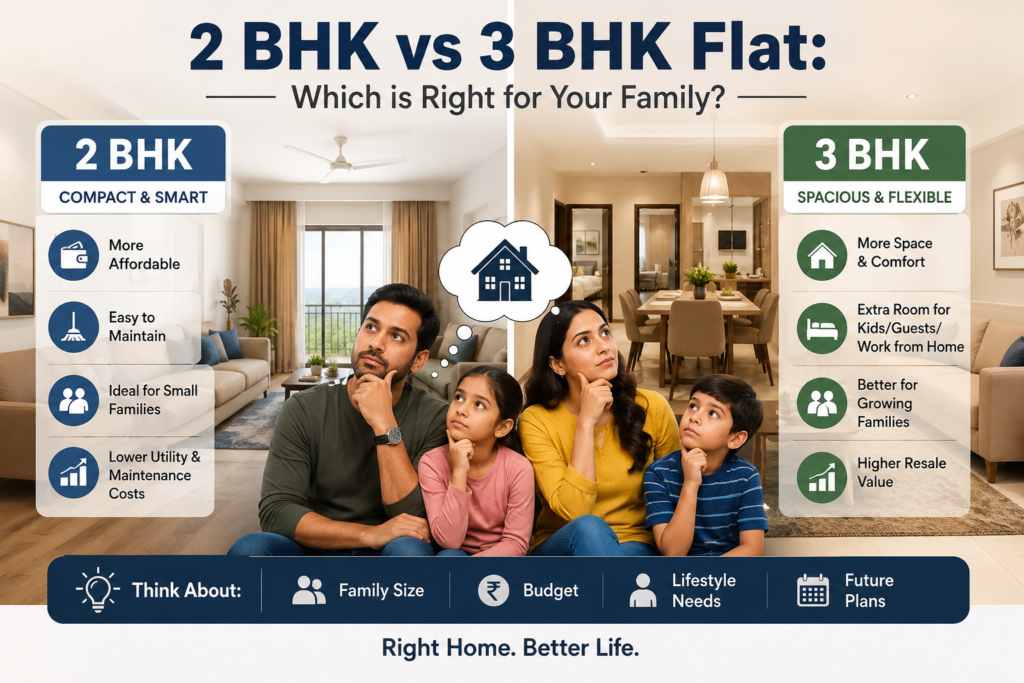
2 BHK vs 3 BHK Flat: Which is Right for Your Family? Choosing between a 2 BHK vs 3 BHK flat is one of the most common dilemmas homebuyers face and it’s rarely just about the number of rooms. It’s about how your family lives today, how it might grow tomorrow, and how much you’re willing to spend to get there. For most buyers, this single decision will shape their monthly budget, their daily routine, and even their long-term financial plans for the next decade or more.
The right flat is the one that fits your life not just your wishlist. A larger home means more comfort and room to grow, but also a bigger EMI and higher maintenance costs. A smaller home keeps your finances manageable, but you might feel cramped sooner than expected. If you’ve been going back and forth on this, here’s a practical breakdown to help you choose with confidence.
The Real Difference Isn't Just "One Extra Room"
On paper, a 3 BHK simply has one more bedroom than a 2 BHK. In practice, that one room changes almost everything your budget, your monthly EMI, your maintenance charges, your furniture needs, your electricity and water bills, and even your resale strategy years down the line. A bigger flat also typically means a larger built-up area, which directly affects the price per square foot you pay, the property tax you’re assessed, and the size of deposit you need to set aside before you even apply for a home loan.
Before deciding, it helps to look at the decision from a few different angles rather than just square footage:
- Financial angle – down payment, EMI, property tax, maintenance, and resale value
- Lifestyle angle – how many people will actually live in the home, and how they use space
- Time horizon angle – whether this is a 5-year home or a 15-year home
- Location angle – in Kerala, a 3 BHK in a Tier-2 town may cost what a 2 BHK costs in a city like Kochi or Trivandrum
Keeping these four lenses in mind makes the decision far less confusing than simply comparing square footage on a brochure.
Who Should Consider a 2 BHK Flat
A 2 BHK works well for buyers in these situations:
Young couples or small families. If you’re newly married or have one young child, a 2 BHK comfortably covers your needs a master bedroom and a second room that can double as a nursery, guest room, or home office. Many young couples also appreciate that a smaller flat is quicker to set up, decorate, and personalize without a large upfront furnishing budget.
First-time buyers on a budget. A 2 BHK typically costs significantly less than a 3 BHK in the same project, which means a smaller down payment, a lower EMI, and more breathing room in your monthly budget. This also means you qualify more easily for a home loan, since banks calculate loan eligibility based on your income-to-EMI ratio a lower EMI requirement opens up more lenders and better interest rate offers.
Investors looking for rental income. 2 BHK flats are in high demand among tenants young professionals and small families making them easier to rent out and quicker to find tenants for, compared to larger units. The rental yield (rent as a percentage of property value) is often comparable to or better than 3 BHKs, since tenant demand is consistently higher for mid-sized homes in most Kerala cities.
Lower maintenance burden. Less space means lower monthly maintenance charges, less furniture to buy, less time spent cleaning and upkeeping the home, and lower electricity costs for cooling and lighting a smaller area. Over a 10-year period, these recurring savings can add up to a meaningful sum.
Buyers who value simplicity. Some families simply prefer a more compact, easier-to-manage home especially working couples with limited time for housekeeping, or older couples downsizing after their children have moved out.
The trade-off is flexibility. If your family grows, or if you frequently host guests or elderly parents for extended stays, a 2 BHK can start to feel cramped within a few years, and you may eventually face the cost and disruption of selling and upgrading.
Who Should Consider a 3 BHK Flat
A 3 BHK makes more sense if:
You have a growing family. Two children of different ages often need separate rooms eventually, especially as they grow older and need their own space for studies and privacy. What feels spacious enough when children are toddlers can feel very tight once they’re teenagers needing quiet space to study.
Elderly parents live with you or visit often. A dedicated room for parents ideally on the ground floor or with an attached bathroom adds comfort and is increasingly a priority for Kerala families with NRI children or aging parents at home. This is a particularly common consideration in Kerala, where many families balance working abroad with caring for parents back home, and a comfortable, private room for parents is often non-negotiable.
You work from home. A spare room as a dedicated home office has become a real necessity for many professionals, and a 3 BHK accommodates this without sacrificing a bedroom. With hybrid and remote work becoming more common, a separate room for calls and focused work away from household noise adds real, everyday value that’s hard to quantify but easy to feel.
You’re thinking long-term. If you plan to stay in the same flat for 10-15+ years rather than upgrading again in a few years, a 3 BHK avoids the cost and hassle of a second move as your family expands. Moving homes isn’t just expensive it involves brokerage fees, registration costs, shifting expenses, and the emotional toll of uprooting children from schools and familiar neighborhoods.
You entertain or host frequently. Families that regularly host relatives, especially during festivals or long vacations common in Kerala households, benefit from the extra room as a guest space rather than constantly rearranging the living room.
Resale and rental value over time. In many Kerala cities, well-located 3 BHK flats hold their value well and attract upgrading families, making them a solid long-term asset, even though the upfront investment is higher. Buyers moving from a 2 BHK to a 3 BHK as their own families grow form a steady demand pool for resale.
The trade-off here is cost. A 3 BHK typically demands a higher down payment, a larger EMI, higher property tax, and higher monthly maintenance so it only makes sense if your budget genuinely supports it without straining your finances. It’s worth running the numbers carefully: a jump from a 2 BHK to a 3 BHK can sometimes increase your EMI by 30-40%, which is a meaningful commitment to take on for 15-20 years.
Quick Comparison
| FACTOR | 2 BHK | 3 BHK |
| Ideal for | Couples, small families, first-time buyers, investors | Growing families, joint families, work-from-home needs |
| Budget & EMI | Lower | Higher |
| Maintenance Cost | Lower | Higher |
| Rental Demand | Generally faster to rent | Smaller pool, but often higher rent |
| Long-term Flexibility | Limited as family grows | More accommodating long-term |
| Resale Appeal | Strong among young buyers | Strong among upgrading families |
| Furnishing Cost | Lower upfront cost | Higher upfront cost |
| Property Tax | Lower | Higher |
| Space for Guests/Parents | Limited | Comfortable |
| Loan Eligibility Required | Easier to qualify | May need higher income proof |
The Financial Math You Shouldn't Skip
Before signing on any flat, it’s worth sitting down with actual numbers rather than going purely on gut feeling. Consider:
- Down payment – Usually 10-20% of the property value. A 3 BHK’s higher price tag means a proportionally larger lump sum needed upfront.
- EMI as a percentage of income – Financial advisors generally recommend EMIs not exceed 40% of your monthly take-home income. Calculate this for both options before falling in love with a particular flat.
- Maintenance charges – Often calculated per square foot, so a 3 BHK’s larger area directly increases this recurring monthly cost.
- Registration and stamp duty – These are calculated as a percentage of property value, so a costlier 3 BHK means higher one-time government charges as well.
- Furnishing and interiors – An extra bedroom typically means an extra bed, wardrobe, and furnishing cost, which can run into a meaningful sum depending on your interior choices.
Running these five numbers side by side, rather than just comparing the listed sale price, often gives a much clearer financial picture.
Questions to Ask Yourself Before Deciding
Rather than just picking based on current family size, it helps to think a few years ahead:
- Are you planning to have more children, or are elderly parents likely to move in with you?
- Will you need a dedicated workspace at home?
- Can your monthly budget comfortably absorb a higher EMI and maintenance cost without cutting into savings or other goals?
- How long do you realistically plan to stay in this home five years, or fifteen?
- Do you frequently host guests, relatives, or extended family for long stays?
- Is your income likely to grow steadily, giving you room to comfortably manage a higher EMI in the coming years?
If your answers point to stability and limited near-term changes, a 2 BHK gives you a smart, budget-friendly start. If you’re planning around a family that will grow or already includes multiple generations, a 3 BHK is usually the better long-term choice, even with the higher initial cost. Before finalizing your decision, make sure you’re also aware of the 5 Critical Mistakes to Avoid When Buying a Flat in Kerala these apply whether you choose a 2 BHK or a 3 BHK.
A Middle Path: Consider the Location Trade-off
One factor many buyers overlook is that the 2 BHK vs 3 BHK decision doesn’t have to be made in isolation from location. A 3 BHK in a slightly less central area can sometimes cost the same as a 2 BHK in a prime location. If extra space matters more to you than being in the heart of the city, exploring a wider radius of locations might unlock the larger flat you actually want, without stretching your budget further than a 2 BHK in a premium area would.
Final Thoughts
There is no universally right answer when it comes to choosing between a 2 BHK and a 3 BHK flat the right choice is always the one that fits your family’s current reality, future plans, and financial comfort. Before making this decision, take the time to map out your next 5 to 10 years honestly. Think about how your family might grow, how your income is likely to change, and how long you realistically plan to stay in this home. The flat that feels perfect today should still feel right several years from now and that kind of long-term fit is what separates a good purchase from a great one.
If you are exploring 2 BHK or 3 BHK flats for sale in Kerala and want expert guidance tailored to your family’s specific needs, lifestyle, and budget, SHAS Properties is here to help. With deep knowledge of Kerala’s residential property market and a genuinely client-first approach, our experienced team helps you compare the right options across locations and price points walking with you from your very first enquiry all the way through to final documentation, making your home-buying journey as smooth, transparent, and stress-free as it deserves to be.